Oil and gas industries are filled with toxic gases, most of which are odorless and colorless. Employees working there are exposed to various health and industrial hazards, courtesy of toxic gases. What is the best alternative if human senses can’t detect a gas? The obvious option is to install a gas detection system across the entire plant. The smart system will allow you to accurately identify explosive, flammable, and toxic gases at the right time.
Gaseous products like Butane, Hydrogen, and Propane are manufactured in the oil and gas industries. These products are easily combustible, and hence the chances of explosion in these industries are high. It is good practice to install a proficient gas detection system across the entire plant to ensure your workers’ health and safety.
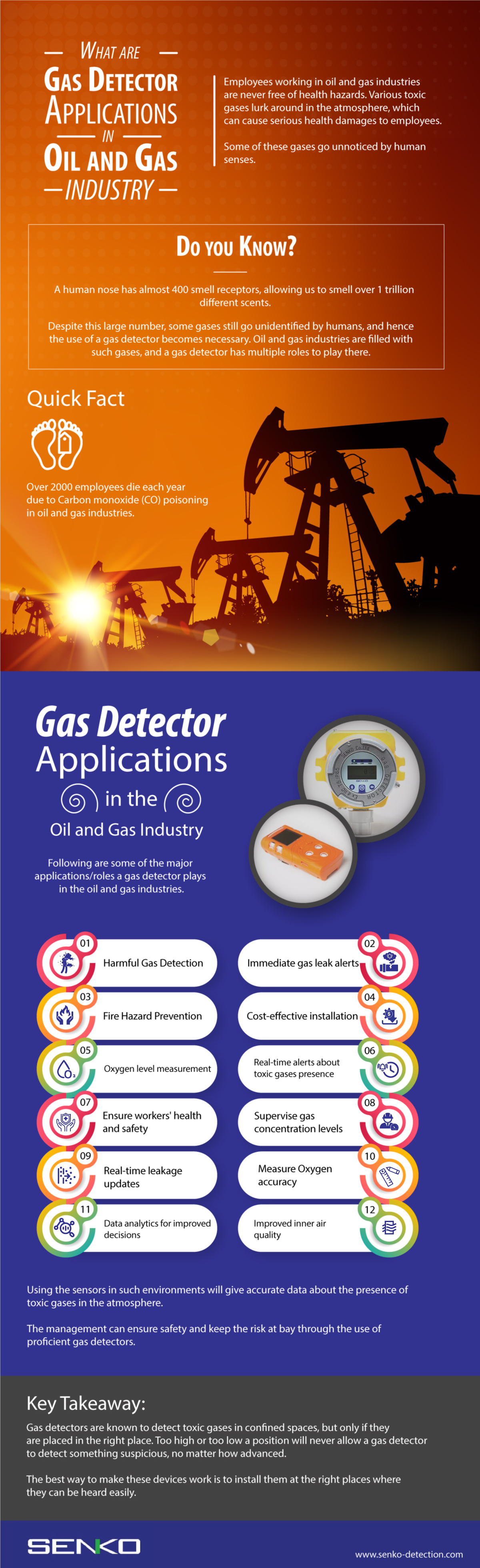
Employees working in oil and gas industries are never free of health hazards. Various toxic gases lurk around in the atmosphere, which can cause serious health damages to employees. Some of these gases go unnoticed by human senses.
Do you know?
A human nose has almost 400 smell receptors, allowing us to smell over 1 trillion different scents.
Despite this large number, some gases still go unidentified by humans, and hence the use of a gas detector becomes necessary. Oil and gas industries are filled with such gases, and a gas detector has multiple roles to play there.
Quick Fact:
Over 2000 employees die each year due to carbon monoxide (CO) poisoning in oil and gas industries.
Gas detector applications in the oil and gas industry:
Following are some of the major applications/roles a gas detector plays in the oil and gas industries.
- Harmful gas detection
- Fire hazard prevention
- Oxygen level measurement
- Real-time alerts about toxic gases presence
- Immediate gas leak alerts
- Cost-effective installation
- Ensure workers’ health and safety
- Supervise gas concentration levels
- Real-time leakage updates
- Measure Oxygen accuracy
- Data analytics for improved decisions
- Improved inner air quality
Using the sensors in such environments will give accurate data about the presence of toxic gases in the atmosphere. The management can ensure safety and keep the risk at bay through the use of proficient gas detectors.
Key Takeaway:
Gas detectors are known to detect toxic gases in confined spaces, but only if they are placed in the right place. Too high or too low a position will never allow a gas detector to detect something suspicious, no matter how advanced. The best way to make these devices work is to install them at the right places where they can be heard easily.
 Gas Detector System